

LbD (Learning by Demonstration) MODULE
In this course, you’ll explore how robots can acquire new skills by observing and imitating human demonstrations rather than being explicitly programmed. We begin by understanding what LbD is and why it’s an increasingly important tool in modern robotic applications. You’ll learn about different methods to demonstrate robotic skills, such as kinesthetic teaching and teleoperation, and how these are used to collect useful data. We’ll then examine how this demonstration data is represented and processed, including key concepts like trajectories and feature encoding. A major focus will be on Dynamic Movement Primitives (DMPs), a powerful method for modeling and generalizing robot movements. Finally, you’ll see how learned behaviors can be tested in simulation and transferred to real robots, bridging the gap between learning and execution.
Open Access Educcation pilot
Lesson Description
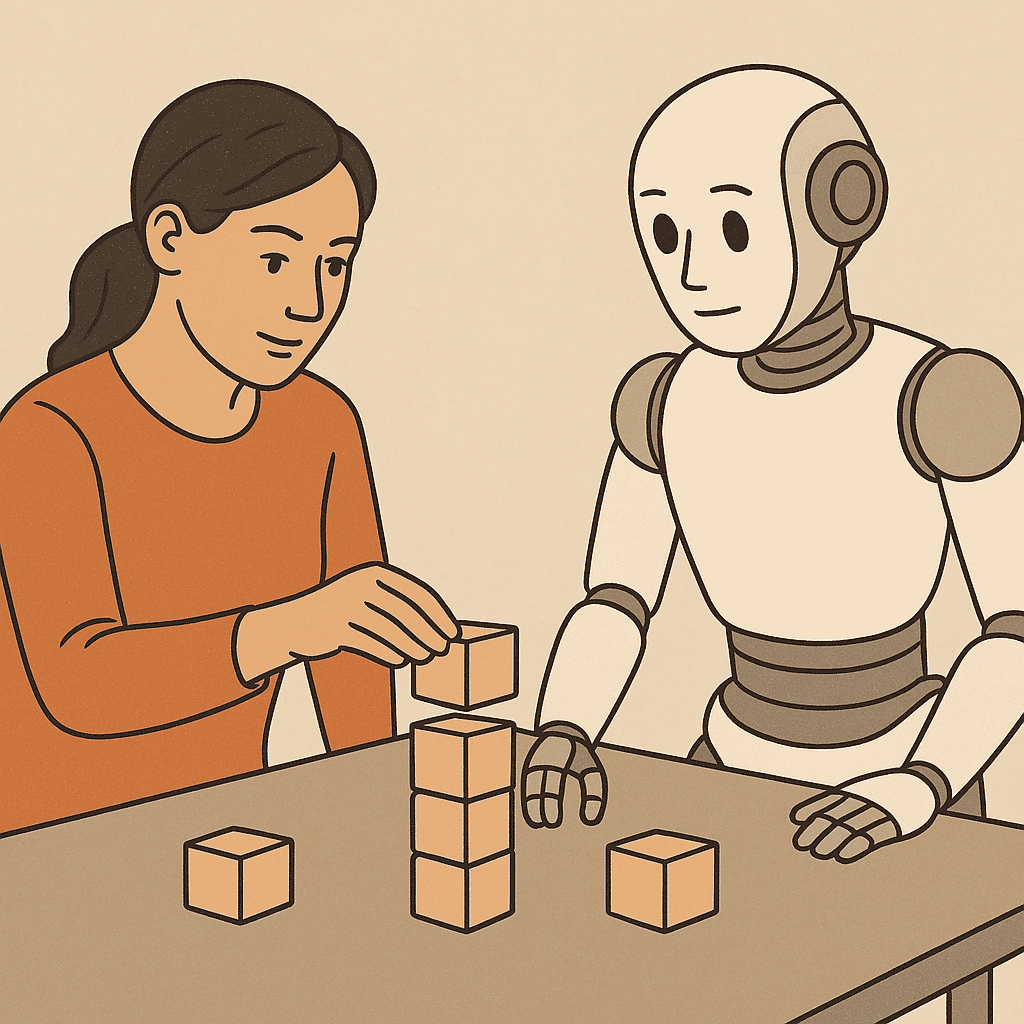
Introduction: What is Learning by Demonstration (LbD) – (Lesson 1): This lecture introduces the concept of Learning by Demonstration, a technique where robots learn tasks by observing human demonstrations. It covers the basic principles and motivations behind using LbD in robotics.
Keywords: LbD, imitation learning, robot training
Why should we use LbD in robotic applications? (Lesson 2): This session explores the advantages of LbD in simplifying robot programming and enabling intuitive human-robot interaction. It also discusses practical scenarios where LbD is especially useful, such as flexible manufacturing or service robotics.
Keywords: usability, human-robot interaction, task learning
Methods for demonstration of robotic skills (Lesson 3): This lecture presents various ways to demonstrate tasks to a robot, such as kinesthetic teaching, teleoperation, and visual observation. It emphasizes the pros and cons of each method depending on the application context.
Keywords: demonstration methods, kinesthetic teaching, teleoperation
Representation of robotic data (Lesson 4): This session focuses on how data from demonstrations is captured, structured, and preprocessed for learning. It includes time-series data, sensor fusion, and robot kinematics.
Keywords: data processing, sensory data, data representation
Trajectory representation with Dynamic Movement Primitives (DMPs) – (Lesson 5): This lecture introduces Dynamic Movement Primitives as a way to model and generalize robot motion trajectories. It explains the mathematical foundations and shows how DMPs can adapt movements to new goals or conditions.
Keywords: DMPs, motion generalization, trajectory learning
Outro: Replication of trajectories in simulation and on a real robot (Lesson 6): The final lecture demonstrates how learned trajectories are executed in simulation environments and then transferred to real robotic systems. It highlights the challenges and considerations of sim-to-real transfer.
Keywords: trajectory execution, simulation, real robot
Learn more
Contact Ernest for more information